


A newly formed island in B.C.'s largest lake has been located...
B.C. Hydro said Monday that the forested land mass, bigger than a Canadian football field, landed ashore after drifting some 30 kilometres northwest of its last known location in the middle of Williston Reservoir. The island's curious appearance, and seemingly sudden disappearance in the massive man-made lake in northern B.C., has captured international attention and intrigue since boaters first made the discovery in August.
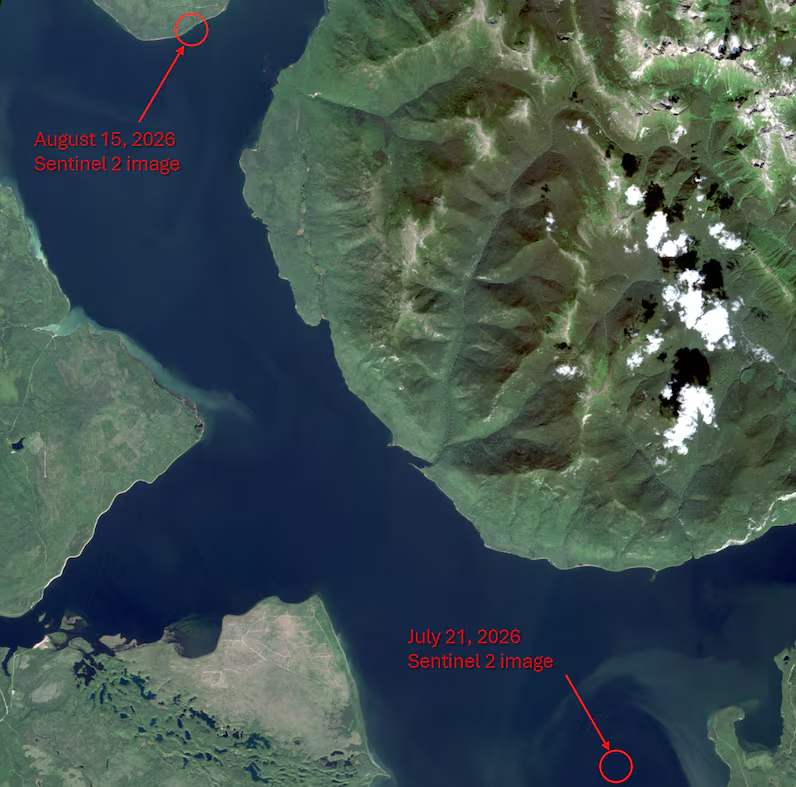
B.C. Hydro spokesperson Bob Gammer said satellite imagery dated Aug. 15 shows the island resting in the north entrance of the Ospika Arm, where the Ospika River flows into the reservoir.
He said the island appears to be intact, and that it has moved even further away from the W.A.C. Bennett Dam connected to the reservoir.
"For it to disappear and now to reappear, that just creates a lot of excitement," Gammer said.
"It's great to know that we found it and it's not causing any trouble right now and hopefully that's the way it stays."
The island's origin still hasn't been confirmed though B.C. Hydro believes record high water levels likely caused it to break off somewhere along the reservoir's sprawling shoreline.
Gammer said strong winds would have moved it through the open waters over the last month.
"It's certainly not current. The water does very slowly move to the east to the [dam]," Gammer said. "The wind is really what's going to drive things."
The Williston reservoir was created in 1968 and is the seventh-largest in the world.
John Clague, an earth sciences professor at Simon Fraser University, said decades of erosion have left the banks of the reservoir vulnerable to landslides.
He said the reservoir is "notorious" for having strong winds that can create waves and currents that undermine shallow rooted trees along the shoreline.
B.C. Hydro estimates the island to be around 70 metres wide and 140 metres long, or about 9,800 square metres in area. "This has to be a world's record in terms of size for floating wood mats with trees that were quite healthy and growing nicely and now are part of an island," said Clague.
B.C. Hydro will want to get a better understanding of where it came from and how it formed, Clague said. "There should be a big scar along the shoreline."
Clague said he's surprised how far the island has travelled, and B.C. Hydro will want to investigate to understand where it came from and how it formed.
That's quite a distance for it to travel and not essentially fall apart," he said. "It's a big piece of real estate, but it's thin. It's not like an iceberg that extends further beneath the water in an ocean."
The island's whereabouts have been a curiosity for residents in northern B.C. as well as interested observers from around the world.
Video of the island bobbing in the middle of the reservoir first went viral in local Facebook groups in early August.
After a decade spent running fishing charters on Williston Lake, Marianne Anderson said she has never seen anything like it.
She said a local fishing guide showed her the video of what looked like a giant carpet of trees, bobbing in the middle of the lake.
The next time fishing guides were in the area, the island was gone.
"It looked unreal," she said.
Finlay Farquhar, a radio engineering assistant based in the United Kingdom, said he was able to track the island's new location using open-source satellite websites after reading about it on social media.
He also found it nestled on the shoreline in the Ospika Arm.
"Quite curious, and it was really quite surprising that there'd been a floating island," Farquhar said. "I was quite surprised by how far it moved."
Gammer said B.C. Hydro was able to locate the island after independently confirming new reports of its location.
Gammer said it's possible the island might move again if strong winds break it free from shore.
"It's nothing that's going to require us to take some serious action," he said.
"We will monitor this just to see what happens, whether it breaks apart and if we then have a debris field instead of one big chunk, that may cause us to take some other action."
He said the island is unstable and boaters should be cautious.
"Go ahead, boat up to it, get near it, take your own pictures, get your drone out, whatever you'd like to do to image it," he said. "But we really warn people about trying to climb on it, as tempting as it may be."
-Matt Prepost CBC News
Add comment
Comments