

“We are extremely concerned about intentionally set wildfires"
Over the 10-year period from 2016 through 2025, there were 14,856 wildfires in British Columbia. Of that total, 560—or about 3.8 per cent—are believed to have been intentionally set.
It’s a small percentage, but also one that is “far too high,” according to B.C. Wildfire Service director Cliff Chapman, who revealed the statistic during a news conference Tuesday.
“We are extremely concerned about intentionally set wildfires anywhere in the province at any time, but given the conditions that we continue to speak of, we are obviously more concerned right now,” Chapman said.
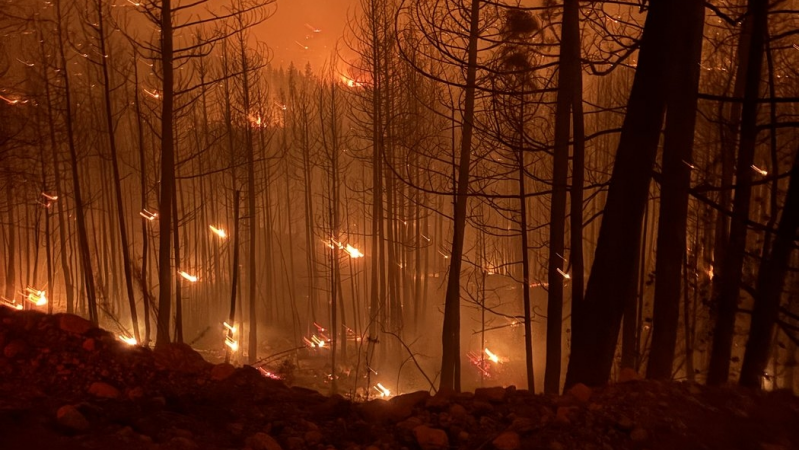
He said the service works closely with the RCMP in investigating all human-caused wildfires, especially those believed to be intentionally set, and he urged people to report any suspicious activity they see.
“If you have seen something around one of our fires, or you see something in the coming days that you think is suspicious, please report it to your local police department,” Chapman said.
The 560 wildfires Chapman was referencing are not all cases that resulted in arson charges. Rather, BCWS fire origin and cause (FOC) investigators classified the blazes as “incendiary,” a category that includes both confirmed arsons and suspicious human-caused fires, according to a wildfire service spokesperson.
“An incendiary fire is one that is intentionally ignited in an area or under circumstances where and when there should not be a fire,” the spokesperson said in an email to CTV News.
“The figure represents the proportion of all wildfires over the 10-year period that were classified as arson or suspicious.”
By this definition, a campfire lit during a campfire ban—if it escaped containment and caused a wildfire—could be considered part of the 3.8 per cent of fires that are intentionally set.
However, the spokesperson said, not all escaped campfires will be classified this way.
“While a campfire lit during a campfire prohibition might be considered to have been intentionally ignited in an area where and when there should not be a fire, FOC investigators would classify it as a campfire-caused wildfire,” the spokesperson said.
It’s only when an investigation by the Natural Resource Officer Service or the RCMP determines an arson charge is warranted that an escaped campfire gets classified as “incendiary” for FOC purposes.
Put simply, not all of the 560 wildfires deemed “intentionally set” over the last decade were set with the specific goal of starting a wildfire. Some may have been, and others were set recklessly, in times and places where open burning was banned.
Chapman’s discussion of arson comes against a backdrop of misinformation and conspiracy theories that seem to spread online whenever environmental disasters occur.
Last week, a fact check by The Canadian Press looked into the claim that the chemical smell of smoke from some wildfires in the country this year is the result of meddling by governments or nefarious actors.
There is no evidence for such a claim.
In recent years, hurricanes and wildfires in the U.S. have been magnets for conspiratorial thinking on social media, with posters claiming—again, without evidence—that the government has manipulated the weather or deliberately set fires using lasers.
A study published in 2025 by the Media Ecosystem Observatory looked at the spread of misinformation and conspiracies on social media in Canada, specifically, and concluded that there are only about 100 very active Canadian users who account for nearly 70 per cent of conspiratorial content.
Awareness of and belief in these conspiracies spreads well beyond this active user group, the study found, with one-third of survey respondents saying they had heard of “intentional wildfire” conspiracies and eight per cent saying they believed them.
At Tuesday’s news conference, Chapman was asked about online misinformation and conspiracies. He said the BCWS works “extremely hard” to be transparent and provide up-to-date information about wildfires in the province.
He said misleading and conspiratorial posts can be demoralizing for firefighters, who sometimes find themselves working long hours while their own homes are subject to evacuation orders.
“The conditions are very challenging, and when you add to those conditions by having misinformation on social media, our people are impacted by that,” Chapman said.
“We want people to know what’s going on. We want people to know what they can expect, and we want to be truthful with everyone in B.C. about what we face.”
With files from The Canadian Press and CTV News Montreal’s Joe Lofaro
Add comment
Comments